The page-by-page guide to tell look-alike exam terms apart and check every case question for owner, insured, trigger and Texas rule

How to stop guessing between two right-looking answers — without memorizing definitions you'll forget by test day 65 illustrated pages.

PDF guide for the Texas Life & Health exam · 65 illustrated topics

BUY NOW

🔒 Secure checkout · PDF by email · 30-day guarantee
69pages · 65 illustrated topics
9 partsfrom contracts to Texas rules
2 booksfree: Case Drills + Review Cards
PDFby email, ready to print

This Is What the Pages You Will Study Look Like

Designed to read on your phone screen while you study at your kitchen table after work.

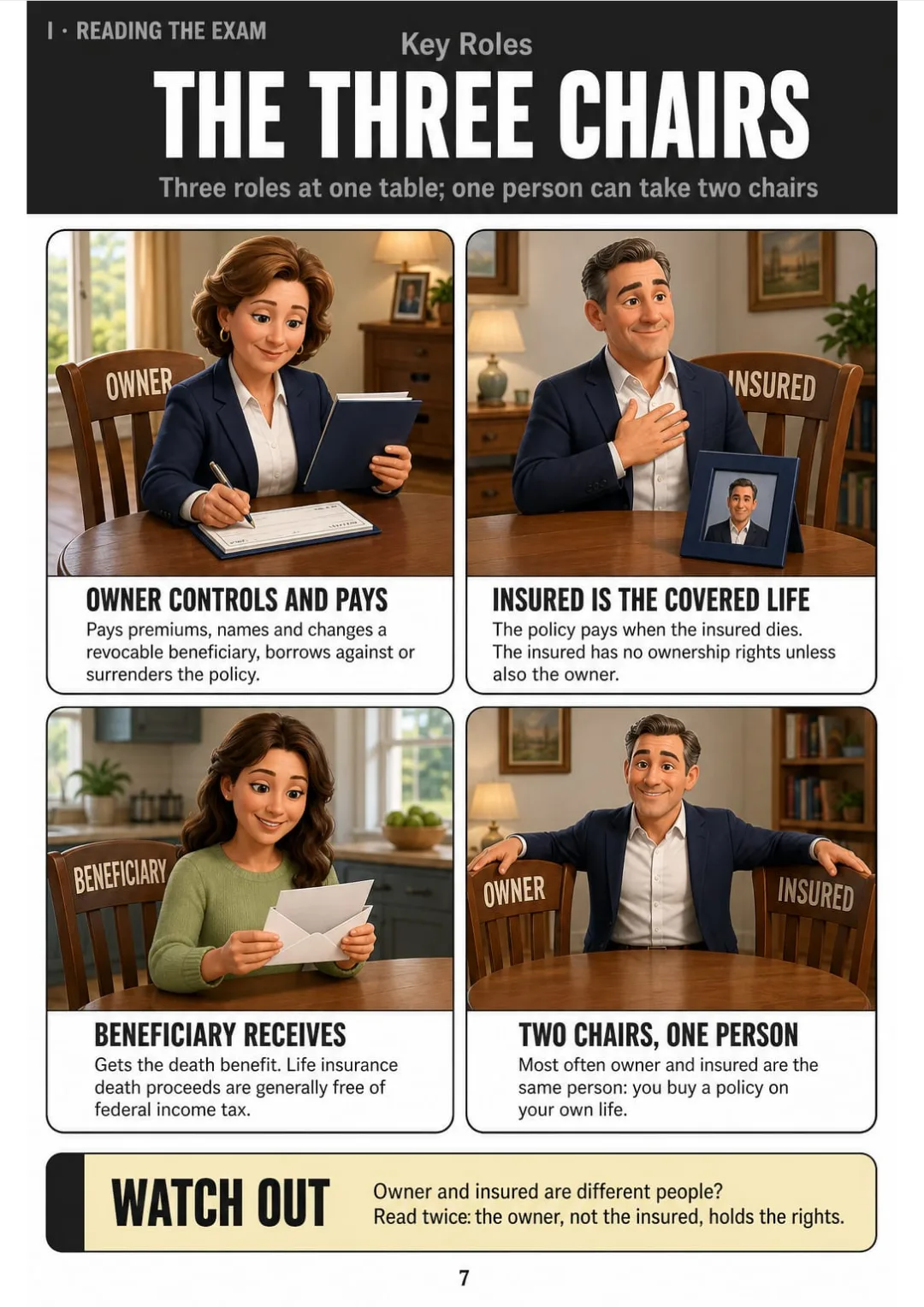
Three chairs: owner controls, insured is covered, beneficiary receives the money.
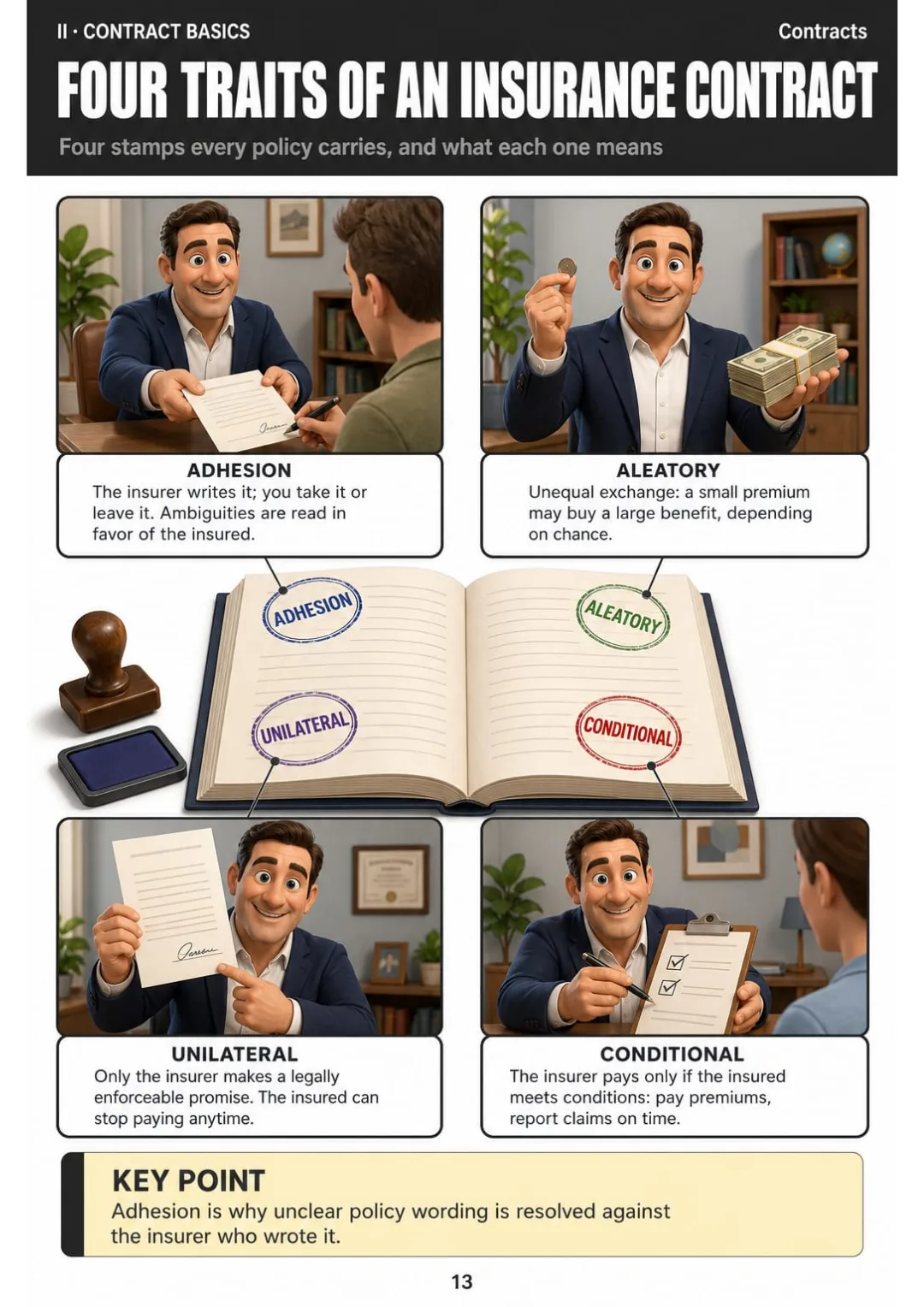
Adhesion, aleatory, unilateral, conditional: four stamps on one policy
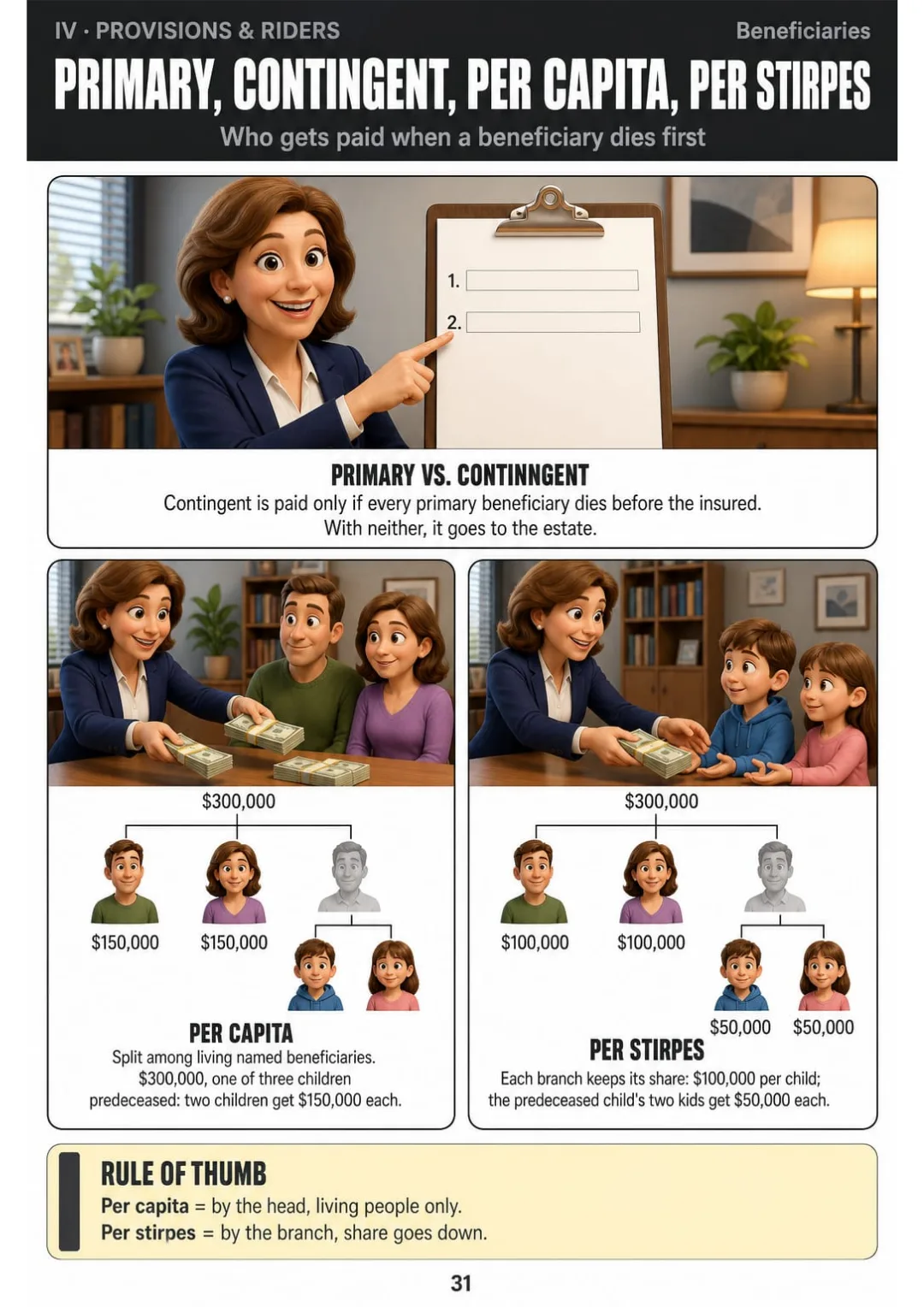
$300,000, 3 children, 1 predeceased: per capita $150,000 each; per stirpes $100,000 per branch.
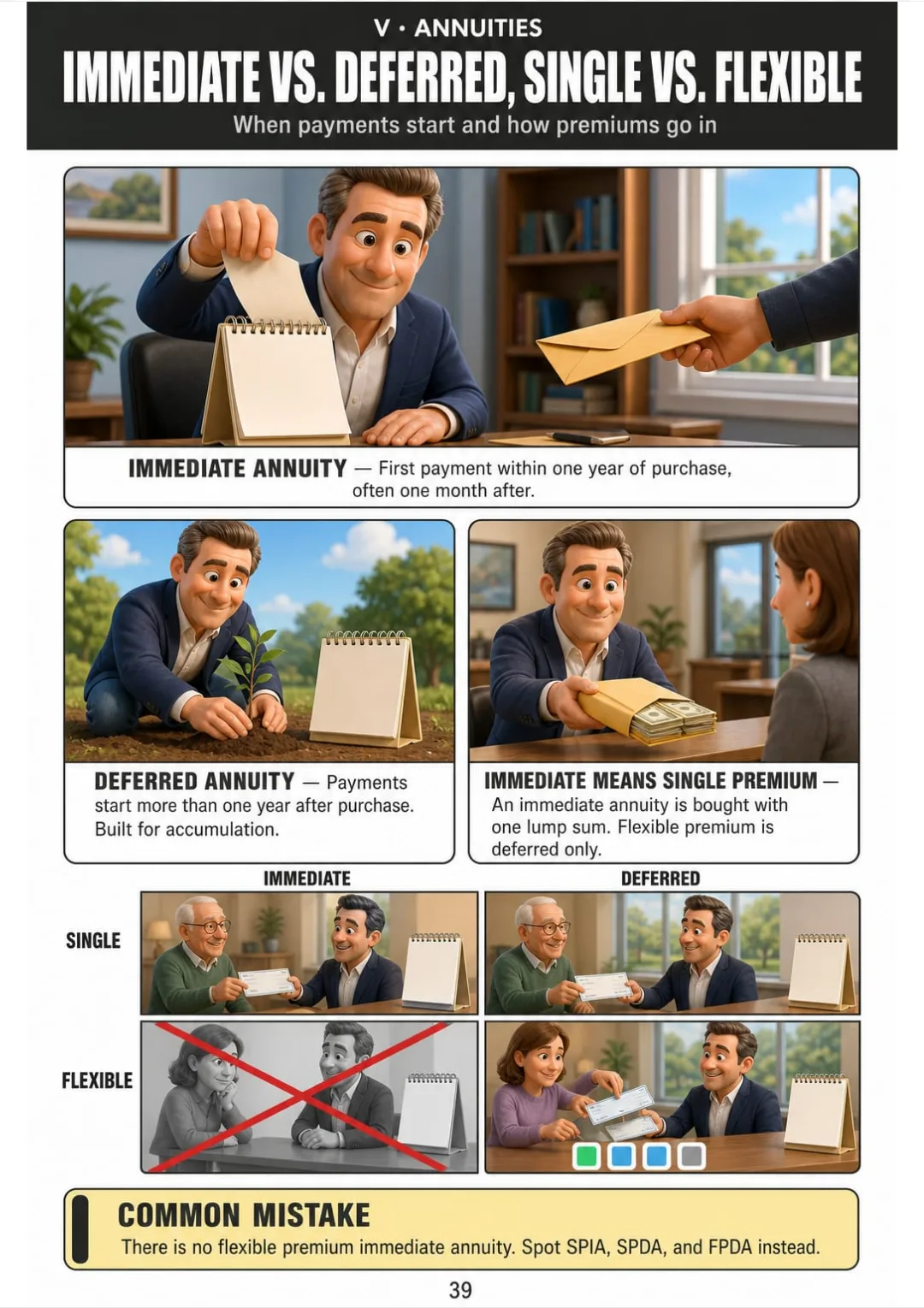
Immediate pays within one year and always takes a single premium.
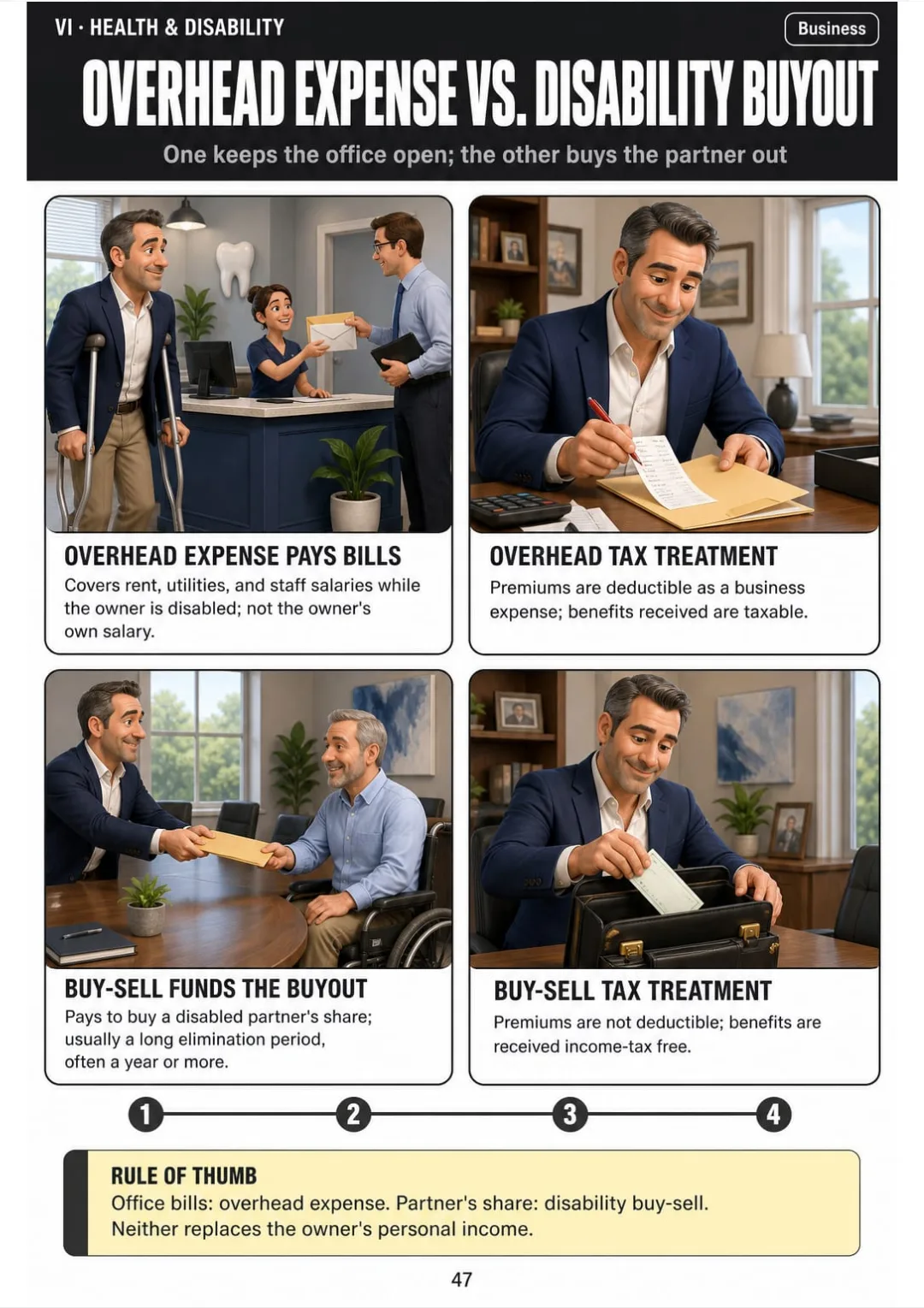
Business overhead expense pays office costs, not owner salary; disability buy-sell funds a partner's buyout.
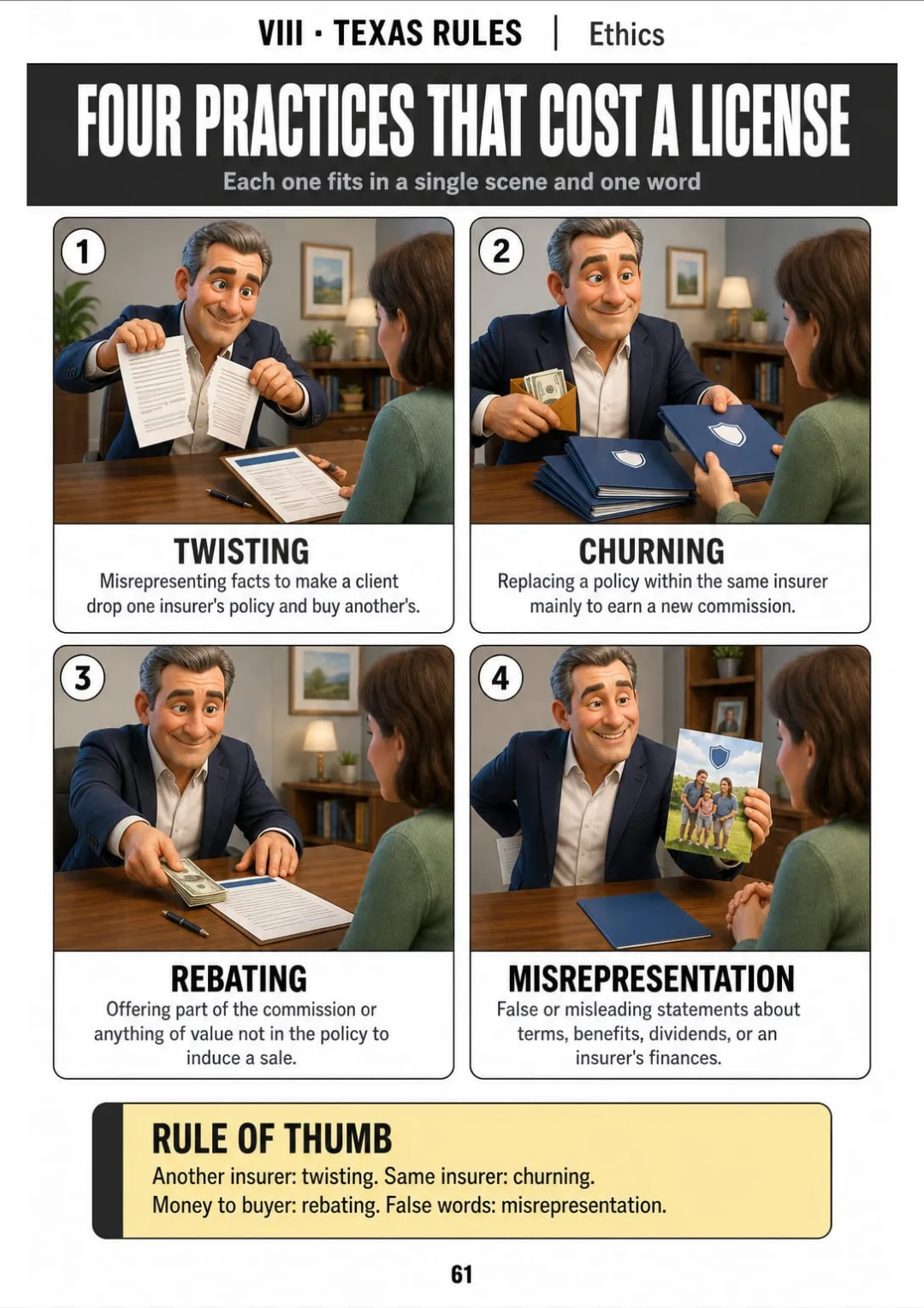
Twisting = other insurer, churning = same insurer, rebating = kickback, misrepresentation = lies.
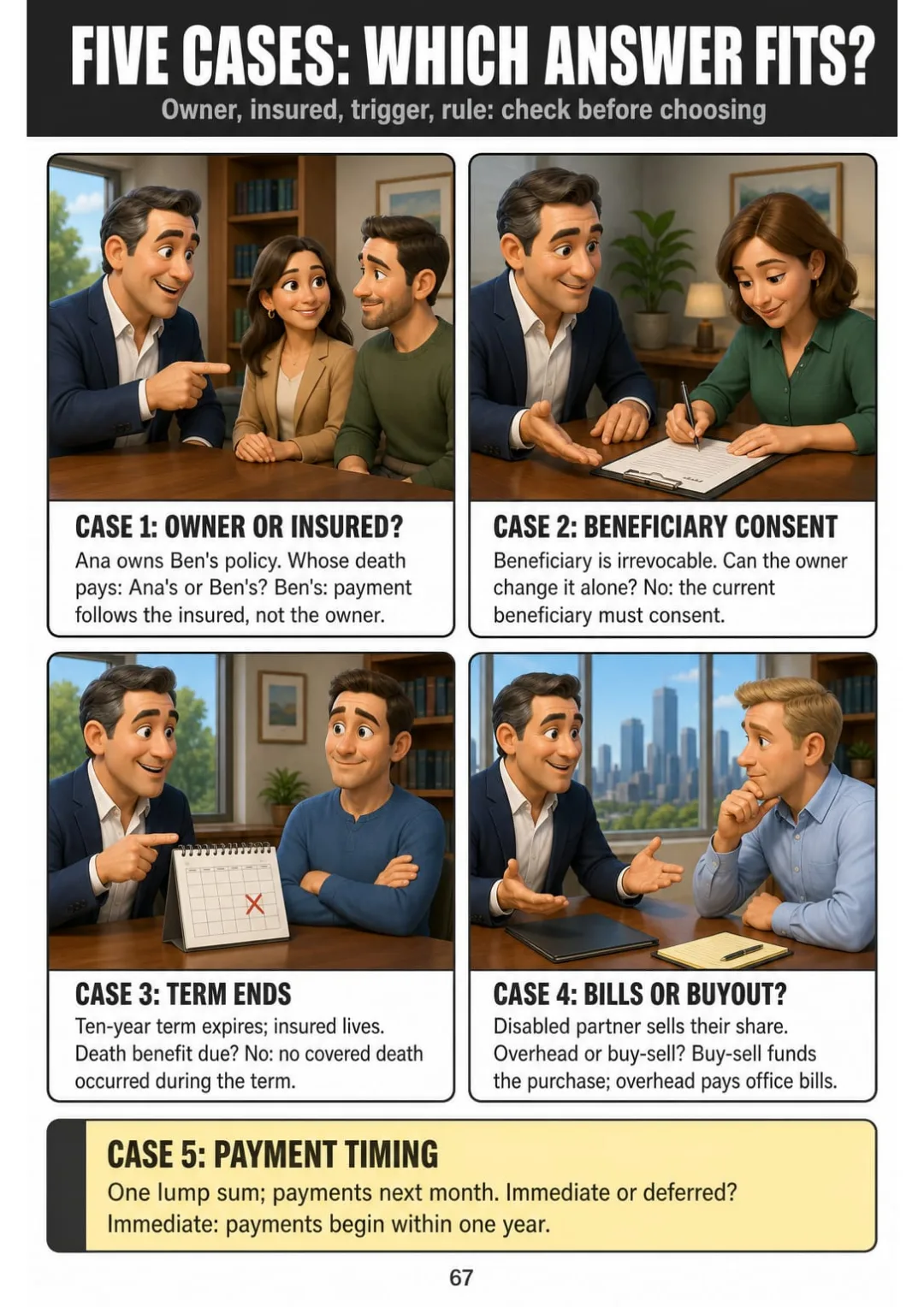
Five hypothetical practice cases with answers and explanations.

Swipe to see more · tap to zoom →

These are real pages from the book. The table of contents is the full one: 9 parts and 65 topics.

Two terms that look alike have to be learned together — not forty pages apart

Practice test, question nine: 'twisting.' You know it's a violation. But twisting or churning? The manual gave each one its own paragraph, chapters apart — and right now neither one comes back.

Next question: 'rebating.' You know that one too. But the four definitions blur together because you learned them one at a time, never side by side.

Every confusing pair in your course lived in a separate chapter, in plain text, with nothing next to it to compare. More study time can't fix a layout problem.

Twisting = other insurer, churning = same insurer, rebating = kickback, misrepresentation = lies.

Twisting: switching to another insurer. Churning: replacing within the same one. Rebating: giving a kickback. Misrepresentation: lying. Four terms, one page, one drawing.

You don't memorize a paragraph. You see the difference.

That's how every confusing pair works in this book.

Another exam fee

The Texas licensing exam costs money every time you sit. Every point lost to a look-alike question is a point you knew — but couldn't sort fast enough under the timer.

Hours re-reading the same manual

You re-read the chapter on unfair practices. The words look familiar. The difference between twisting and churning still doesn't stick, because a paragraph can't show it.

Doubt in front of the screen

Sixty seconds left on a case question. Two answers look right. You guess. That doubt follows you into the next question and the one after that.

BUY NOW

🔒 Secure checkout · PDF by email · 30-day guarantee

SEE THE DIFFERENCE

The same topic, studied two ways

THIS
  • Read a long paragraph defining owner, insured, and beneficiary
  • Highlight three definitions and hope you remember which is which
  • Take a practice test and guess when two answers look alike
The policyowner, also known as the policyholder, holds all incidents of ownership, including the right to name and change the beneficiary (provided the designation is revocable), assign the policy, select settlement and nonforfeiture options, and borrow against the cash value. The insured is the individual upon whose life the policy is issued and whose death triggers payment of the death benefit to the designated beneficiary. The beneficiary is the party named by the policyowner to receive the death benefit proceeds upon the insured's death, and may be primary or contingent, revocable or irrevocable.
FOR THIS
  • See three chairs on one page: owner controls, insured is covered, beneficiary receives
  • Spot the difference in one drawing, not in three paragraphs
  • Work the case in 4 steps and know why the wrong answer is wrong
Three chairs: owner controls, insured is covered, beneficiary receives the money.
CONTENTS

Take a Look at the 9 Parts and 65 Topics

From how to read an exam question to Texas rules and ethics — nine parts, each drawn, each pair of look-alike terms side by side.

IHow to Read an Exam Question · pp. 5-8
  1. How This Book Works: One Topic, One Page, Twin Pages
  2. The 4-Step Case Method
  3. Owner, Insured, Beneficiary: The Three Chairs
  4. Why Two Answers Look Right
IIInsurance and Contract Basics · pp. 9-16
  1. Risk: Pure vs. Speculative
  2. Peril vs. Hazard
  3. Law of Large Numbers and Adverse Selection
  4. The 4 Elements of a Contract
  5. Insurance Contract Traits: Adhesion, Aleatory, Unilateral, Conditional
  6. Insurable Interest: When It Must Exist
  7. Representation vs. Warranty vs. Concealment
  8. Agent Authority: Express, Implied, Apparent
IIILife Insurance Policies · pp. 17-26
  1. Term vs. Whole Life: Twin Page
  2. Level, Decreasing, and Increasing Term
  3. Whole Life Variations: Ordinary, Limited-Pay, Single Premium
  4. Universal Life: The Flexible Account
  5. Variable and Variable Universal Life
  6. Joint Life vs. Survivorship Life
  7. Group Life and the Conversion Right
  8. Business Uses: Key Person, Buy-Sell, Executive Bonus
  9. Modified Endowment Contracts and the 7-Pay Test
  10. Viatical vs. Life Settlement
IVProvisions, Options, and Riders · pp. 27-35
  1. Entire Contract and Incontestability
  2. Grace Period and Reinstatement
  3. Misstatement of Age and Suicide Clause
  4. Revocable vs. Irrevocable Beneficiary: Twin Page
  5. Primary, Contingent, Per Capita, Per Stirpes
  6. Nonforfeiture Options: Cash, Reduced Paid-Up, Extended Term
  7. Dividend Options
  8. Settlement Options
  9. Common Riders: Waiver of Premium, Accidental Death, Guaranteed Insurability
VAnnuities · pp. 36-41
  1. Life Insurance vs. Annuity: Opposite Jobs
  2. Accumulation vs. Annuitization Phase
  3. Fixed vs. Variable vs. Indexed
  4. Immediate vs. Deferred, Single vs. Flexible Premium
  5. Payout Options: Life Only, Period Certain, Refund, Joint and Survivor
  6. Annuity Taxation and Qualified Plans
VIHealth, Accident, Disability, and Long-Term Care · pp. 42-51
  1. Deductible vs. Copay vs. Coinsurance vs. Out-of-Pocket Max
  2. HMO vs. PPO vs. POS vs. Indemnity
  3. Basic vs. Major Medical vs. Comprehensive
  4. Exclusion vs. Limitation vs. Waiting Period
  5. Disability Income: Own Occupation vs. Any Occupation
  6. Disability Business Uses: Overhead Expense and Buyout
  7. Accidental Death and Dismemberment
  8. Uniform Health Provisions: Claim Timeline
  9. Health Grace Period by Premium Mode
  10. Long-Term Care: Benefit Triggers
VIIGroup Coverage and Government Programs · pp. 52-57
  1. Group Health: Eligibility, Enrollment, and Coordination
  2. COBRA Continuation
  3. Medicare Parts A, B, C, D
  4. Medicare Supplement vs. Medicare Advantage: Twin Page
  5. Medicaid and Social Security Disability
  6. ACA Basics and HIPAA Privacy
VIIITexas Rules and Ethics · pp. 58-64
  1. The Texas Department of Insurance and the Commissioner
  2. The General Lines Life, Accident, Health and HMO License
  3. Agent Duties and Record-Keeping
  4. Unfair Trade Practices: Twisting, Churning, Rebating, Misrepresentation
  5. Replacement: Step by Step
  6. Underwriting, Privacy, and Consumer Reports
  7. Guaranty Association and License Renewal
IXFinal Review · pp. 65-69
  1. The Look-Alike Pairs on One Page
  2. Numbers and Timeframes to Review
  3. Five Cases: Which Answer Fits?
  4. Frequent Mistakes and How to Spot Them
  5. Your Last-Week Checklist

Each concept gets a page. Each look-alike gets the page next to it.

Every concept has a page and a picture. Look-alike terms sit on facing pages, so the pair is in front of you at the same time — you compare instead of trying to recall a paragraph.

$300,000, 3 children, 1 predeceased: per capita $150,000 each; per stirpes $100,000 per branch.

$300,000 benefit, three children, one predeceased. Per capita: $150,000 each to the two survivors. Per stirpes: $100,000 per branch.

One drawing, one example with real numbers. Next time a question says 'per stirpes,' you picture the family tree and follow the branch.

If it's drawn, you don't have to memorize it.

BUY NOW

🔒 Secure checkout · PDF by email · 30-day guarantee

Here Is What You Get with Texas Life & Health Exam, Page by Page:

Ipp. 5-8

How to Read an Exam Question

The 4-step case method and why two answers always look right.

IIpp. 9-16

Insurance and Contract Basics

Risk, contracts, insurable interest, and agent authority — the foundation drawn.

IIIpp. 17-26

Life Insurance Policies

Term, whole, universal, variable, group, and business uses of life insurance.

IVpp. 27-35

Provisions, Options, and Riders

Beneficiaries, nonforfeiture options, dividends, settlements, and common riders.

Vpp. 36-41

Annuities

Fixed, variable, indexed annuities, payout options, and taxation basics.

VIpp. 42-51

Health, Accident, Disability, and Long-Term Care

Deductibles, managed care plans, disability income, and long-term care triggers.

VIIpp. 52-57

Group Coverage and Government Programs

COBRA, Medicare parts and supplements, Medicaid, ACA, and HIPAA.

VIIIpp. 58-64

Texas Rules and Ethics

TDI, licensing, unfair practices, replacement rules, and the guaranty association.

IXpp. 65-69

Final Review

Every look-alike pair on one page, key timeframes, five worked cases, and a last-week checklist.

And That Is Not All: 2 More Books, Free

Texas Life & Health Case Drills

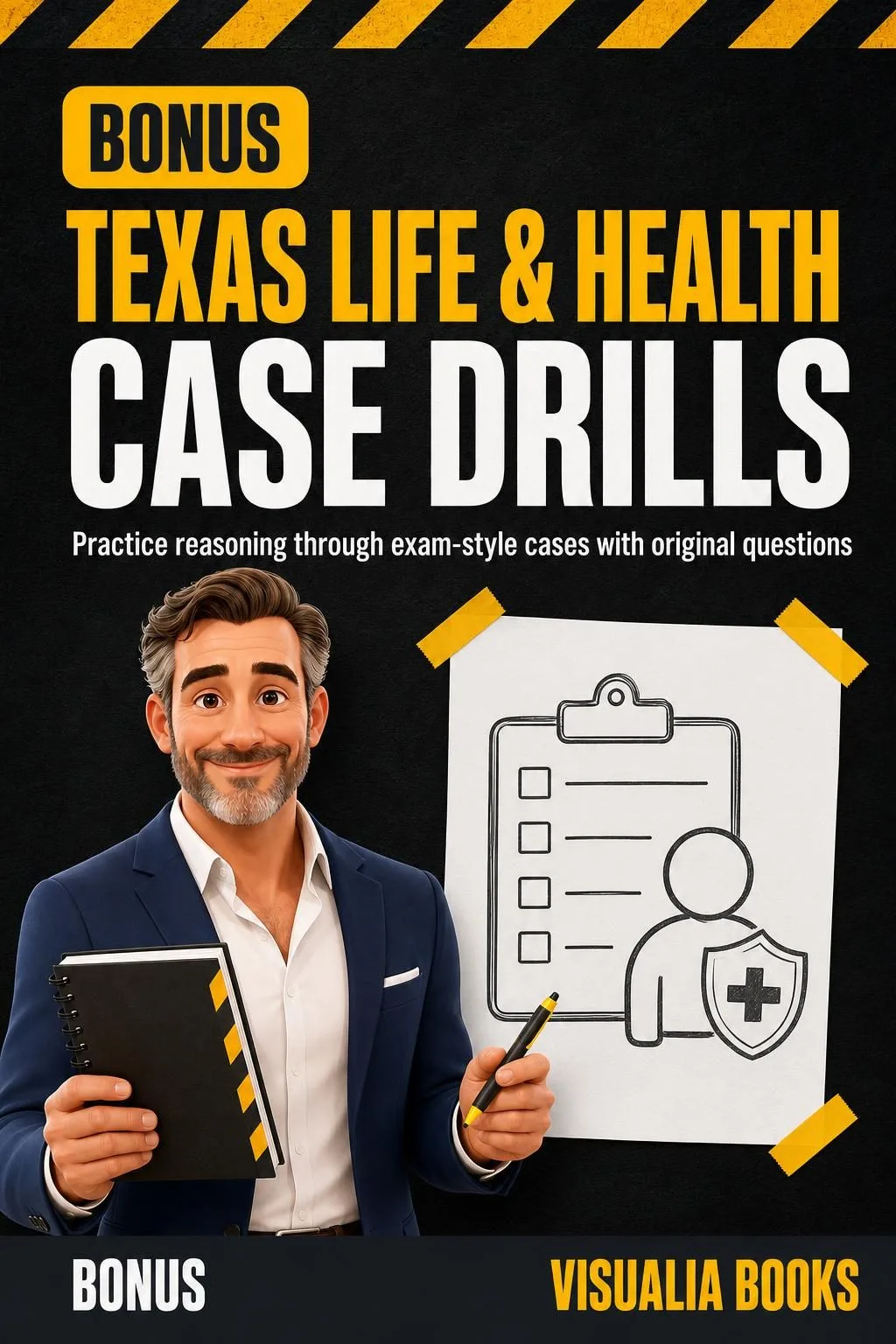
BONUS 1: «Texas Life & Health Case Drills»

Value on its own: US$ 17.90

Practice reasoning through exam-style cases with original questions, and see exactly why every wrong option is wrong.

Look-Alike Terms: Side-by-Side Review Cards

BONUS 2: «Look-Alike Terms: Side-by-Side Review Cards»

Value on its own: US$ 14.90

Review the pairs that trip people up most often, one card each, so you can sort them at a glance the week before your exam.

Texas Life & Health Exam, Page by Page + 2 Free Books

  • Texas Life & Health Exam, Page by Page: 65 illustrated pagesUS$ 63
  • BONUS 1: Texas Life & Health Case DrillsUS$ 17.90
  • BONUS 2: Look-Alike Terms: Side-by-Side Review CardsUS$ 14.90
  • High-resolution PDF to printIncluded
Total value US$ 95.80
YOUR PRICE:
US$ 27
You save US$ 68.80
BUY NOW

📄 This is a digital PDF book sent to your email: nothing is printed or shipped.

Secure purchaseEncrypted payment30-day guarantee

PDF by email: Texas Life & Health Exam, Page by Page reaches your inbox as a PDF, and the two free books come by email too. One-time payment, no installments or hidden costs.

Is this for you?

Career changer with a test date

Career changer with a test date

You finished prelicensing and your Pearson VUE exam is coming up. You need to sort the terms you keep confusing, not re-read the manual one more time.

New agency hire who needs the license

New agency hire who needs the license

Your manager said 'get licensed.' You study after work and need material that fits on a phone screen and gets to the point.

Someone who hasn't taken an exam in years

Someone who hasn't taken an exam in years

It's been decades since your last test. You don't need more text — you need each concept drawn once, clearly, in order.

To Sum Up: Here Is What You Get

US$ 95.80US$ 27
BUY NOW

📄 This is a digital PDF book sent to your email: nothing is printed or shipped.

30DAYS
GUARANTEE

30-Day Guarantee

30-day guarantee: tell us what didn't work and we'll refund 100%.

100% money-back guarantee for 30 days. Use it to study for your exam. If it doesn't help you tell look-alike terms apart or work cases with confidence, tell us what didn't work and we'll refund every cent.

Frequently Asked Questions

Is this a printed book or a digital file?

This is a 69-page digital PDF delivered by email: 65 illustrated topic pages, plus the cover and three contents pages. The printed page numbers include those four opening pages. Read it on your phone, tablet or computer, or print it.

Can I read it on my phone?

Yes. Every page is designed for a phone screen — one topic, one drawing, no scrolling.

Does this work if I'm just starting to study?

Yes. It starts from the basics and builds page by page. No prior knowledge needed beyond your prelicense course.

How do I get the material?

PDF by email, sent to the address you enter at checkout. The book and the two bonus books all come in the same email. You can save the files and print them.

Is this a one-time payment?

Yes. One payment, no subscription, nothing recurring.

Is this an official TDI or Pearson VUE product?

No. This is independent study material, not affiliated with TDI or Pearson VUE. It's written for the Texas General Lines – Life, Accident, Health and HMO exam, not a generic all-states guide. The content is checked against the current Pearson VUE content outline for that exam and the Texas Insurance Code, and Part 8 covers Texas rules: TDI, licensing, replacement and the guaranty association.

I already paid for a prelicense course. Is this the same thing?

No. Your prelicense course teaches terms one by one. This book puts the confusing pairs side by side and gives you a 4-step case method. It's a visual study companion, not a replacement for your course.

Does this replace my prelicense education?

No. This book isn't a prelicense course: it doesn't count toward any education hours and doesn't come with a certificate. It's a visual study companion to use alongside or after your course.

Are these real exam questions?

No. Every question in the book is original and written for this material. They follow the content outline topics but are not official exam questions. All numerical examples are hypothetical.

One Last Thing Before You Decide...

Next time the practice test shows you two answers that look right, you'll see the drawing — and the difference will be obvious.

You don't need to study more. You need to see it drawn, once, clearly.

The book, the Case Drills, and the Look-Alike Review Cards are ready.

Open the book at your kitchen table. See the first twin page. That's the moment studying stops feeling like guessing.

One-time payment: US$ 27 · Guarantee: 30 days · PDF by email

BUY NOW

📄 This is a digital PDF book sent to your email: nothing is printed or shipped.